
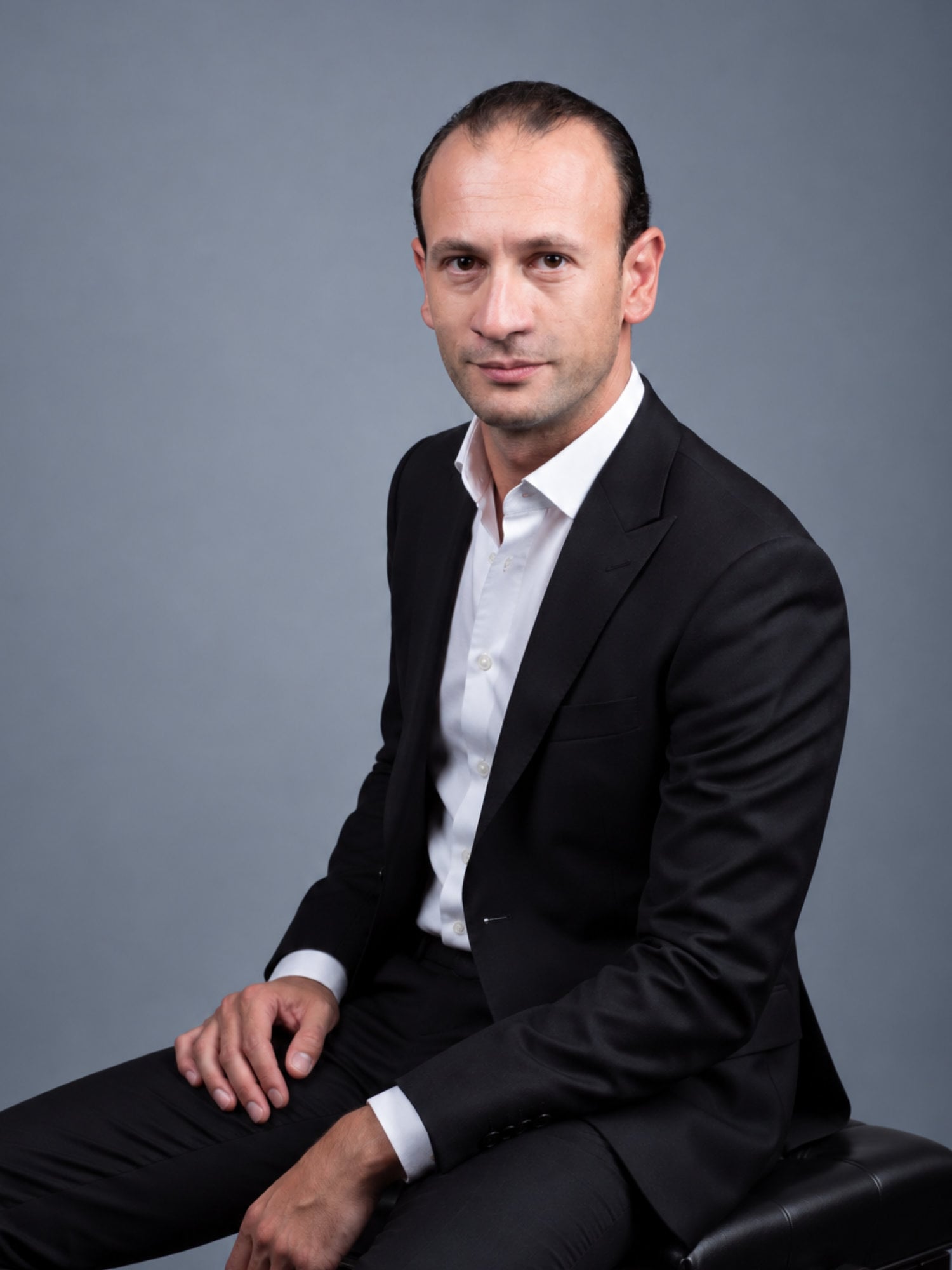
Ashot Khachatourian
Pianist
Ashot Khachatourian is an Armenian pianist whose artistic identity is distinguished by his emotional intensity, profound musical sensitivity and uncompromising commitment to the truth of musical expression. Recognised as one of the compelling pianistic voices of his generation, he combines a formidable command of the instrument with an individual artistic vision, bringing to the concert stage a rare combination of virtuosity, spontaneity and expressive depth.
He began studying the piano at the age of five with Valentina Melikyan and Elena Galustova at the Charles Aznavour Music School in Armenia. His artistic development continued under the guidance of Gérard Wyss in Basel, Eliso Virssaladze in Fiesole and, most significantly, Maria João Pires at the Queen Elisabeth Music Chapel in Brussels. These formative encounters shaped a musical philosophy rooted in sincerity, imagination and the search for the essential meaning of every musical phrase.
Khachatourian came to international prominence through a series of distinguished competition successes, winning First Prize at the Rachmaninov Piano Competition in 2006 and First Prize at the Martha Argerich Piano Competition in 2007. He subsequently received prizes at the Top of the World International Piano Competition in 2011 and the Concours d’Épinal in 2013. Particularly admired for his interpretations of Rachmaninov’s Second and Third Piano Concertos, he brings to the Romantic repertoire both commanding pianistic power and a deeply personal expressive language.
His international career has brought him to celebrated concert halls and cultural institutions, including the Concertgebouw in Amsterdam, the Berliner Konzerthaus, Salle Pleyel, Salle Cortot, Salle Gaveau, BOZAR and Flagey in Brussels, Cadogan Hall in London, Concertgebouw Brugge, De Singel in Antwerp, TivoliVredenburg in Utrecht and Stiftung Mozarteum in Salzburg. He has performed with orchestras including the London Chamber Orchestra, the Norwegian Radio Orchestra, the Orchestra of the Eighteenth Century, the Basel Symphony Orchestra and Le Concert Olympique, collaborating with distinguished conductors such as Daniele Gatti, Thomas Søndergård, Christopher Warren-Green, Jan Caeyers, Rodolfo Fischer and Augustin Dumay.
Chamber music occupies an equally essential place in his artistic life. He has collaborated with some of the most distinguished musicians of our time, including Misha Maisky, Maxim Vengerov, Cho-Liang Lin, Ivan Monighetti, Zakhar Bron, Gary Hoffman and Gérard Caussé. For Khachatourian, chamber music is not merely an extension of the solo repertoire, but an intimate form of musical dialogue in which listening, imagination and shared expression become inseparable.
His discography reflects this broad artistic perspective. His recordings for Azur Classical include a solo album devoted to Haydn and Beethoven, a Chopin album released in 2019, and Encores, released in 2024. In June 2026, he released Brahms: Violin Sonatas, featuring the complete sonatas for violin and piano by Johannes Brahms, performed with violinist Hrachia Avanesyan. Bringing together three of the most profound works in the chamber repertoire, this recording explores the expressive richness, lyrical intimacy and dramatic architecture of Brahms’s musical language. The album received a magnificent review from Klassiek Centraal, which described the experience with the striking words “Brahms moved to tears.”
Beyond the concert stage, Khachatourian is the founder and artistic director of the YSAYE International Music Competition, established in 2018. Through this initiative, he extends his commitment to musical excellence to the next generation of performers, creating opportunities for young artists and contributing actively to the international classical music community.
Whether performing as a soloist, collaborating in chamber music or shaping new artistic opportunities, Ashot Khachatourian approaches music as a living and deeply personal form of expression. His artistic world is defined not simply by virtuosity, but by the conviction that music must communicate something essential: an emotion, a truth, an experience that transcends borders and speaks directly to the listener.
As Maria João Pires’s words so aptly suggest, his musicianship is ultimately driven by the inseparable forces of truth, energy, passion and artistic freedom.

Related events
Landscapes of the Soul
20 December 2026 | time 19:15
Sala delle Verifiche - Complesso Monumentale dello Steri